

What Is A Value Proposition?
A value proposition is a clear statement explaining why someone should choose an offer and what useful value they will receive. It connects a customer’s need with the main benefit provided by a product, service or business.
A good value proposition helps people quickly understand whether an offer is relevant to them.
What A Value Proposition Means
Customers normally want to know three things:
- Is this offer meant for someone like me?
- How will it help me?
- Why should I choose it?
A value proposition gives clear answers to these questions.
It is not only a product description. A description tells people what the product is or which features it includes. A value proposition explains why those features are useful to the customer.
For example, a bicycle business could say:
We provide bicycle repairs.
This identifies the service, but it does not clearly explain the value.
A stronger version could be:
Convenient bicycle repairs for local commuters who need to get back on the road quickly and safely.
The second statement identifies the customer, their need and the useful result.
The Four Parts Of A Value Proposition
A clear value proposition normally contains four connected ideas.
Customer
Begin by deciding whom the offer is designed to help.
“Everyone” is rarely a useful answer. Different groups often have different needs, budgets, experience levels and priorities.
A bicycle repair service might focus on local adults who use bicycles to travel to work. Another workshop might focus on competitive cyclists who need specialist equipment and detailed performance adjustments.
Both businesses repair bicycles, but they help different customers.
A clear customer group makes the rest of the value proposition easier to create.
Need
Next, identify the customer’s main need, problem or desired result.
A customer may want to:
- Save time
- Reduce confusion
- Learn a skill
- Solve a practical problem
- Feel more confident
- Make a difficult task easier
The need should be real and closely connected to the offer.
For example, a bicycle commuter with a loose chain may need a reliable repair without waiting several days. The immediate problem is the damaged bicycle, but the deeper need is dependable daily transport.
Listening to customers, reading their questions and observing their behaviour can help a business understand what genuinely matters to them.
Market research gives a business a more organized way to collect evidence about these customer needs and behaviours.
Main Benefit
The main benefit explains the useful result the customer can receive.
Features and benefits are connected, but they are not the same.
A feature is something an offer contains. A benefit explains how that feature helps the customer.
For example:
- Feature: Same-day bicycle repair appointments
- Benefit: The customer can return to normal journeys sooner
A value proposition normally focuses on the most meaningful benefit rather than listing every possible feature.
Clear Difference
The final part gives the customer a reason to consider this particular offer.
The difference does not need to be dramatic or completely unique. It only needs to be relevant and truthful.
A useful difference could be:
- Simpler instructions
- Faster local service
- Personal guidance
- A method designed for beginners
- Flexible delivery
- A calm customer experience
- Specialist knowledge
The difference should support the customer’s need. Being different has little value when the difference does not matter to the people the business wants to help.
A Simple Value Proposition Example
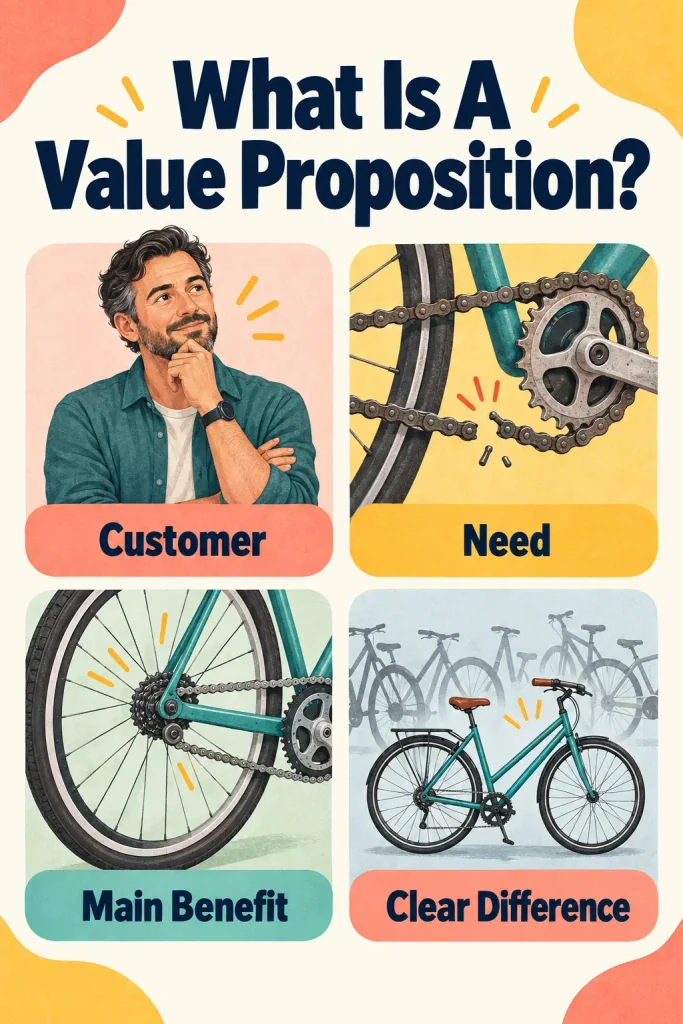
Imagine a local bicycle repair service.
Its first value proposition might be:
We offer high-quality bicycle repairs.
This sounds positive, but it is vague. It does not identify the customer, explain the main benefit or show what makes the service suitable.
A clearer version could be:
Convenient bicycle repairs for local commuters who need dependable transport, with simple booking and same-day service for common problems.
This statement includes the four main parts:
- Customer: Local bicycle commuters
- Need: Dependable daily transport
- Main benefit: Returning to the road quickly
- Clear difference: Simple booking and same-day help for common repairs
The statement does not promise that every bicycle can be repaired immediately. It clearly explains what the service is designed to provide.
Why A Value Proposition Matters
A value proposition gives direction to more than advertising.
It can guide:
- Website headlines
- Product descriptions
- Social media content
- Email messages
- Sales conversations
- Product development
- Customer service
A marketing channel is the route used to carry this value proposition to the people it is designed to help.
When the value proposition is clear, a business can make more consistent decisions. Understanding the customer journey can show where this promise must remain clear and consistent as people discover, compare and use the offer.
For example, a repair service that promises convenience should make its opening times, prices and booking process easy to find. The customer experience should support the promise.
A clear value proposition can also help customers decide whether an offer suits them. This is useful even when the answer is no. Marketing should help people make informed choices, not pressure everyone to buy.
A Simple Value Proposition Template
Use this sentence to create a first version:
We help [customer] who need [need or desired result] by providing [main benefit] through [relevant difference].
For example:
We help local bicycle commuters who need dependable transport by providing convenient repairs through simple booking and same-day help for common problems.
You can also use a shorter customer-facing version:
[Offer] for [customer] who want [main benefit] without [common difficulty].
For example:
Convenient bicycle repairs for local commuters who want to return to the road without a long wait.
The template is only a starting point. Rewrite the sentence until it sounds natural and accurately describes the offer.
Free Value Proposition Builder
Would you like to create a clear value proposition for your own business or offer?
Download the free two-page Value Proposition Builder. You can print it and use it to identify your customer, their main need, the benefit you provide and what makes your approach a suitable choice. It also helps you check your evidence, improve your wording and choose one practical next step.
Common Beginner Mistakes
One common mistake is trying to include too much.
A value proposition should communicate the most important value quickly. A long list of features can make the main idea difficult to find.
Another mistake is using vague claims such as:
- High quality
- Excellent service
- The best solution
- Great results
- Innovative products
These phrases provide little useful information unless the business explains what they mean.
A third mistake is focusing entirely on the business. Company history and experience may support trust, but customers still need to understand how the offer can help them.
Businesses should also avoid promises they cannot support. A value proposition should be attractive, but it must remain honest.
Finally, a value proposition should not be treated as permanent. It can improve as the business learns more about its customers and the results they value.
A Simple First Step
Write short answers to these four questions:
- Who do we help?
- What do they need?
- What useful result do we provide?
- Why is our approach a suitable choice?
Combine the answers into one or two sentences.
Read the statement aloud. Remove unnecessary words and check whether a new visitor could understand it without additional explanation.
A first version does not need to be perfect. It needs to be clear enough to test, use and improve.
Final Thoughts
A value proposition explains whom an offer helps, what need it addresses, which benefit it provides and why it is a suitable choice.
The strongest value propositions are clear, relevant and honest. They help customers understand an offer while giving the business a focused direction for its marketing.
Marketing Made Simple.