

What Is A Marketing Campaign
A marketing campaign is a coordinated set of marketing activities created to reach a specific audience and achieve one clear goal. The activities may appear in several places, but they share the same purpose, message and plan.
Without that shared plan, a beginner can easily spend time posting, emailing and making offers without knowing what the work should achieve. A campaign turns those separate actions into one focused effort.
What a Marketing Campaign Means
A marketing campaign is not the same as all the marketing a business does. Your general marketing may continue throughout the year. A campaign is a focused part of that work.
For example, a business might run a campaign to:
- introduce a new product
- attract people to an event
- collect email subscribers
- bring past customers back
- increase bookings for one service
- create awareness of a new business
A campaign normally has a beginning, an end and a result that can be measured. It may last a few days, several weeks or longer, depending on the goal. The important point is not the length. The important point is that all activities support the same result.
How a Marketing Campaign Works
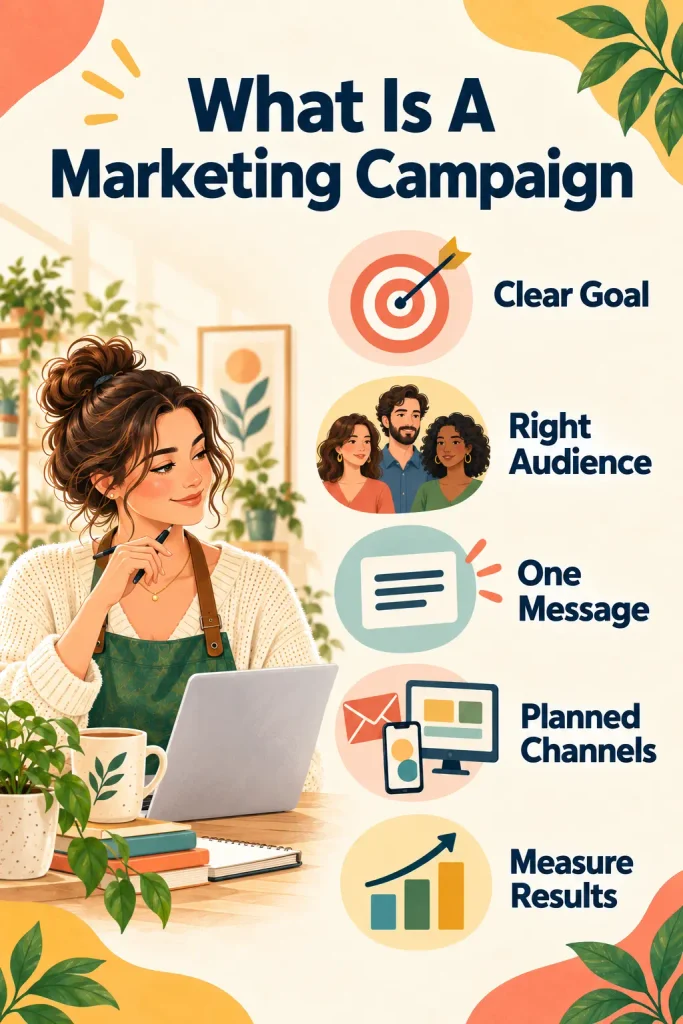
A simple campaign can be built from five connected parts.
1. Choose one clear goal
First, decide what you want the campaign to achieve. A goal such as “do more marketing” is too broad because it does not tell you what success looks like.
A clearer goal might be to receive 20 bookings for a beginner workshop, sell a new product, or gain 50 new email subscribers. The exact number should be realistic for your situation. You do not need an impressive target. You need a useful one.
2. Define the audience
Next, decide who the campaign is for. A message aimed at everyone usually becomes weak because different people care about different things.
Think about the people most likely to need the offer. What problem are they trying to solve? What do they already know? What may make them hesitate? These questions help you create a campaign that feels relevant rather than pushy.
3. Create one central message
The central message explains what you are offering and why it matters to the audience. It should remain consistent even when the wording changes slightly between platforms.
For example, a bakery promoting a new lunch menu may use the central message: fresh weekday lunches that are quick and easy to collect. An email can explain the menu in detail, while a social post shows one meal. Both still communicate the same promise.
4. Plan the channels and timing
Channels are the places where people receive the campaign. They may include email, social media, search, a website, printed material or communication inside a physical shop.
You do not need to use every available channel. It is usually better to choose a few places that your audience already uses. A small realistic plan is often more effective than a complicated plan that becomes difficult to complete.
Timing also matters. Decide when the campaign starts, when each activity appears and when the campaign ends. This helps the different parts support one another.
5. Measure the result
Choose a main measurement that matches the goal. If the goal is workshop bookings, count bookings. If the goal is email subscribers, count new subscribers. Likes and views may offer useful extra information, but they should not replace the result you actually wanted.
After the campaign, compare the result with the goal. Then note what worked, what was difficult and what you would change next time.
A Simple Marketing Campaign Plan
| Campaign part | Simple question | Bakery example |
| Goal | What should happen? | Increase weekday lunch orders |
| Audience | Who should respond? | People working near the bakery |
| Message | Why should they care? | Fresh lunches that are quick to collect |
| Channels | Where will they see it? | Email, social media and an in-store sign |
| Timing | When will it run? | Two working weeks |
| Measurement | What result will you count? | Lunch orders during the campaign |
This simple plan keeps the campaign connected. The bakery is not sending unrelated messages through random channels. Every action supports the same audience, promise and goal.
Why Marketing Campaigns Matter
Campaigns make marketing easier to understand and evaluate. They help a business decide what to say, where to say it and what to measure.
They also make learning possible. If everything changes at once and no goal is defined, it is difficult to know why a result happened. A focused campaign gives you a clearer starting point for the next attempt.
This does not mean every campaign will succeed. Marketing always includes uncertainty because people make their own decisions. However, a clear campaign gives you better information than a collection of unplanned activities.
Common Beginner Mistakes
One common mistake is choosing too many goals. A campaign that tries to build awareness, gain subscribers, sell several products and promote an event at the same time can become confusing. Choose the main result first.
Another mistake is using too many channels. Each channel needs suitable content, time and attention. Start with the places that are most likely to reach the audience.
A third mistake is changing the message too often. Variety can keep content interesting, but the central promise should stay clear.
Finally, some beginners measure only visible reactions such as likes. Those reactions may help, but the main measurement should match the campaign goal.
A Simple First Step
Write one sentence using this structure:
We will [action] for [audience] so that [goal], measured by [result].
For example: “We will promote our weekday lunch menu to nearby office workers so that we increase lunch orders, measured by the number of lunch purchases during two weeks.”
This sentence does not complete the whole campaign, but it gives every later decision a clear direction.
Final Thoughts
A marketing campaign brings several marketing activities together around one goal. It identifies the audience, keeps the message consistent, coordinates the channels and measures the result.
The campaign does not need to be large to be useful. Start with one realistic goal and a plan you can actually complete. Clear thinking matters more than making the campaign look complicated.
Marketing Made Simple.