

What Is A Target Market?
A target market is the group of people a business chooses to serve because they share needs or traits that make its offer relevant to them. Understanding this group helps the business create suitable products, messages and marketing activities.
A target market does not need to include everyone who might possibly buy. It describes the people the business believes are the best fit for what it offers.
What A Target Market Means
A market includes all the people or businesses that may have an interest in a type of product or service.
A target market is the part of that larger market a business decides to focus on.
Imagine a shop that sells outdoor clothing. Its wider market could include many people who spend time outside. However, the shop might focus on adults who enjoy day hikes, need comfortable waterproof clothing and prefer simple equipment.
That smaller, clearer group is its target market.
People within a target market may share:
- A similar problem or need
- Common interests
- A particular age range or life situation
- A location
- Similar buying habits
- A suitable budget
- A reason for choosing the product
Not every person in the group will be identical. The purpose is to find meaningful similarities that connect people to the offer.
How A Target Market Works
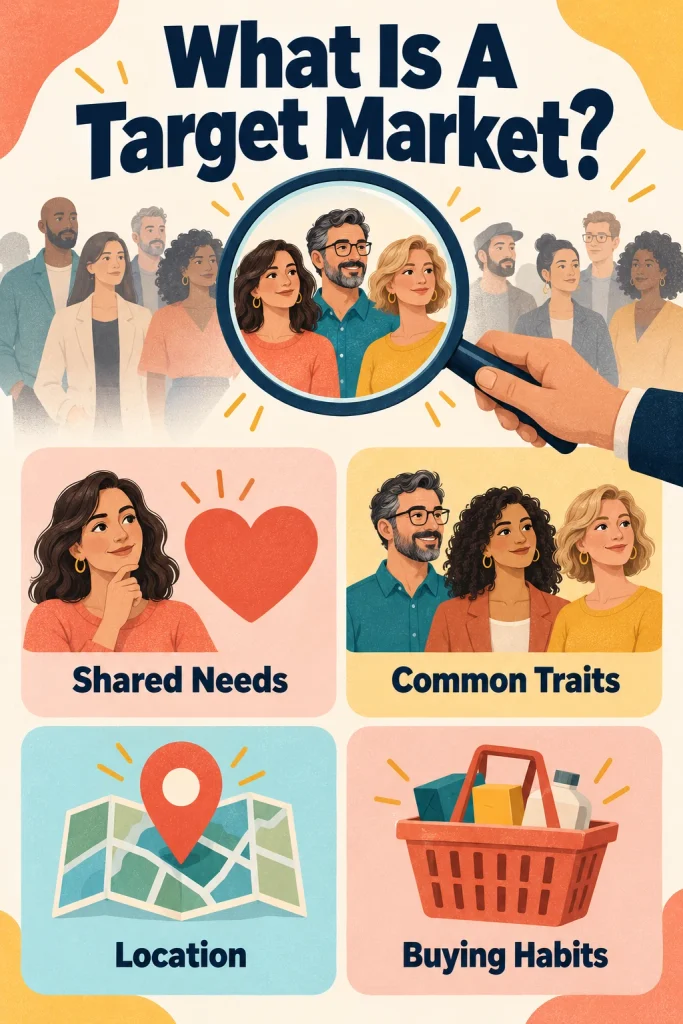
A business can begin identifying its target market by examining four useful areas.
Shared Needs
The strongest connection within a target market is often a shared need or problem.
A bicycle repair service might focus on adults who use their bicycles for travelling to work. These customers need reliable repairs because their bicycles are part of their daily transport.
Another bicycle shop might focus on people who enjoy mountain biking. Those customers may need different products, repairs and advice.
Both groups use bicycles, but their needs are not the same.
Understanding the need helps the business explain how it can provide a useful solution.
Common Traits
People in a target market may share traits that affect what they need or how they buy.
These traits could include:
- Age or stage of life
- Work situation
- Interests
- Income range
- Family situation
- Experience level
- Values or priorities
A business should use only the traits that are relevant to the offer.
For example, knowing that someone is a complete beginner may matter to a piano-learning website. Knowing the person’s hair colour probably does not.
Useful traits explain why the offer fits the group. Unrelated details only make the description longer.
Location
Location can be important for a local business.
A café, garden service or bicycle repair shop normally needs customers who live, work or travel nearby. Its target market may therefore include people within a particular town or area.
Location can also matter online. A business may serve a certain country because of language, delivery costs, payment methods or local rules.
Other online businesses may serve people in many countries. In that case, shared needs and interests could matter more than physical location.
Buying Habits
Buying habits describe how people search for, compare and purchase products or services.
A business might consider questions such as:
- Where do these people look for information?
- Do they compare several alternatives?
- What makes them trust a business?
- Do they prefer buying online or in person?
- How often do they need the product?
- What may prevent them from buying?
The answers help the business decide where and how to communicate.
Buying habits should be based on real observations whenever possible. A first description may begin as an informed idea, but the business should improve it as it learns from customers.
Market research can help a business discover which needs, characteristics and buying habits its potential customers share. Studying the customer journey can reveal how people in the target market discover, compare and purchase an offer.
A Simple Target Market Example
Imagine a local bicycle repair service.
It could describe its target market as:
Adults living or working nearby who use bicycles for regular transport and need reliable, convenient repairs.
This description provides a clear starting point.
Shared need: A safe and dependable bicycle.
Common traits: Adults who cycle regularly and depend on their bicycles.
Location: People living or working within the service area.
Buying habits: They may search online for a nearby repair shop, read reviews and value clear prices and convenient booking.
The service can now make more focused decisions.
It could create a webpage explaining common repairs, display its location and opening times clearly and offer a simple booking process.
Its message could focus on dependable service and helping customers return to their normal journeys quickly.
The target market does not prevent other people from using the service. A casual cyclist can still become a customer. The description only identifies the group that the business will focus on first.
Target Market And Target Audience
These terms are related, but they are not always used in exactly the same way.
| Target market | Target audience |
|---|---|
| The wider group a business wants to serve | The specific people a message or campaign aims to reach |
| Often guides products and long-term marketing | Often guides one advertisement, article or campaign |
| May contain several smaller groups | Can be one smaller group within the target market |
| Describes likely customers | Describes the intended viewers, readers or listeners |
For example, a company’s target market might be adults who want to learn piano at home.
The target audience for one article could be complete beginners who want to understand how to read their first five notes. Another article could speak to adults returning to piano after many years.
Both audiences belong to the same wider target market.
In everyday marketing, people sometimes use the two terms in similar ways. The useful point is not memorising a perfect distinction. It is knowing whom the business or message is meant to help.
Why A Target Market Matters
A clear target market helps a business focus its limited time, money and attention.
It can influence:
- Which products or services the business develops
- How those offers are explained
- Which examples and images are used
- Where the business publishes its marketing
- Which customer questions it answers
- What kind of experience it provides
Without a clear focus, marketing can become vague. A message that tries to speak to everyone may not feel especially useful to anyone.
A target market makes the message more relevant. The business can talk about real needs instead of using broad claims.
It also helps the business make choices. A marketing opportunity may sound interesting, but it may not be useful if the target market is unlikely to see it or care about it.
A clear target market also helps a business create a value proposition that speaks directly to the right group.
Common Beginner Mistakes
One mistake is describing the target market as “everyone.”
A broad group can feel safe because it does not exclude anyone. However, it gives the business very little guidance about products, messages or marketing channels.
Another mistake is choosing traits that do not affect the buying decision. A useful target market description includes details that explain why the offer fits the group.
Some businesses create an imaginary description without speaking to customers or observing real behaviour. A first idea is acceptable, but it should be tested and improved.
It is also possible to make the target market too narrow. If the description includes many unnecessary conditions, the business may ignore suitable customers.
Finally, a target market should not be treated as a permanent rule. Customer needs, business offers and markets can change. The description should develop when new information becomes available.
A Simple Target Market Worksheet
Use these questions to create a first description:
Shared need:
What problem or desired result connects these people?
Common traits:
Which characteristics genuinely affect their need or buying decision?
Location:
Where do they live, work, shop or search?
Buying habits:
How do they find information and choose a solution?
Business fit:
Why is this business’s offer suitable for them?
Now complete this sentence:
Our target market is [group of people] who [share this need] and want [desired result].
For the bicycle repair service, this becomes:
Our target market is adults living or working nearby who depend on their bicycles and want reliable, convenient repairs.
The description can remain simple. It only needs to help the business make clearer decisions.
Free Target Market Worksheet
Would you like to create a first target market description for your own business?
Download the free two-page Target Market Worksheet. You can print it and use it to explore shared needs, relevant traits, location, buying habits and business fit. It also helps you test your description and choose one clear next step.
Final Thoughts
A target market is a chosen group of people who share needs or traits that connect them to a business’s offer.
A useful description focuses on relevant needs, characteristics, location and buying habits. It gives the business direction while remaining open to improvement as more is learned.
The goal is not to exclude everyone else. It is to understand whom the business can help most clearly.
Marketing Made Simple.