

What Is A Marketing Strategy? A Simple Explanation
A marketing strategy is a clear plan for reaching the right people and showing them why they should choose a business. It connects a business goal with a specific audience, a useful message, and suitable ways to communicate that message.
Without a strategy, marketing can become a collection of unrelated activities. A business might publish social media posts, send emails, or pay for advertising without knowing what those activities are supposed to achieve.
A marketing strategy gives those activities a shared direction.
Watch the simple explanation:
What A Marketing Strategy Means
A marketing strategy explains how a business intends to attract and serve customers.
It normally begins with a goal. The business then identifies the people it wants to reach, learns what those people need, and creates a clear reason for them to pay attention.
The strategy also determines where and how the business will communicate.
For example, a local bakery and an online software company may both use marketing, but they will probably need different strategies. The bakery may focus on nearby customers through local search, social media, and community events. The software company may use educational articles, email marketing, and online demonstrations.
The tools are different because the audiences, products, and goals are different.
A marketing strategy is therefore not just a list of marketing channels. It explains why particular channels and messages have been chosen.
A marketing plan then turns this overall direction into organized actions, a budget and a schedule.
How A Marketing Strategy Works
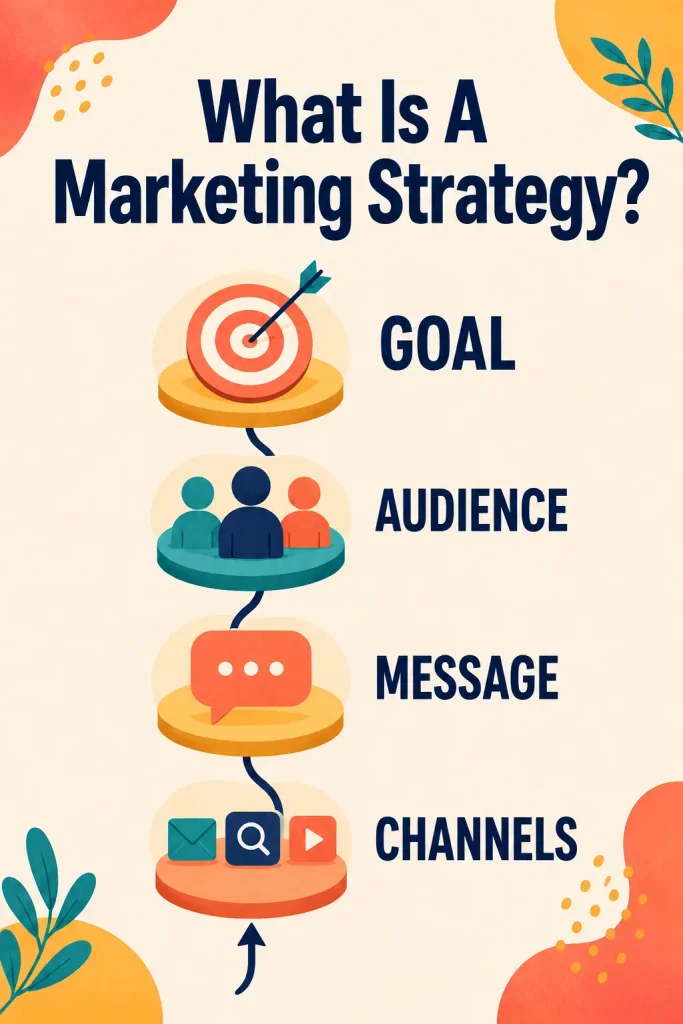
A simple marketing strategy connects several basic decisions.
1. Choose a goal
The first step is deciding what the business wants its marketing to accomplish.
A goal could be:
- Attract more website visitors
- Generate enquiries
- Increase sales of a particular product
- Build awareness in a local area
- Encourage existing customers to return
A clear goal helps the business avoid spending time on activities that do not support the desired result.
“Get more attention” is quite broad. “Help more local families discover our beginner swimming lessons” is more useful because it identifies both the desired action and the audience.
2. Understand the audience
The next step is identifying the people the business wants to help.
A business does not need to reach everyone. It needs to reach people who have a problem, need, or goal connected to what the business offers.
Useful questions include:
- Who is the product or service for?
- What problem are these people trying to solve?
- What matters to them when choosing a solution?
- What questions might they ask before buying?
- Where do they normally look for information?
Understanding the audience makes the marketing more relevant. It allows the business to speak about real customer needs instead of describing only its own products.
Defining a clear target market helps the business focus on the people most likely to need its offer.
3. Create a clear message
The marketing message explains what the business offers and why it is useful.
A clear message does not need to be clever or complicated. It should help the audience understand three things:
- What the business provides
- Who it helps
- What useful outcome it creates
For example:
Simple bookkeeping support for independent tradespeople who want to spend less time managing paperwork.
This is clearer than saying:
We provide innovative financial solutions for modern businesses.
The first message identifies the service, audience, and benefit. The second sounds impressive but gives the reader less useful information.
A value proposition can help shape this message by connecting the audience’s need with the offer’s main benefit.
4. Choose marketing channels
Marketing channels are the places where a business communicates with potential customers.
These may include:
- A website
- A blog
- Search engines
- Social media
- Local directories
- Advertising
- Events
- Referrals
The right channel depends on the audience and the business goal.
A business does not need to use every available platform. One or two well-chosen channels can be more useful than maintaining many channels without a clear purpose.
5. Observe and improve
A strategy provides direction, but it can still change.
The business can observe which topics attract attention, which pages receive visits, which emails get clicks, and which activities lead to enquiries or purchases.
These observations help the business improve its approach.
Marketing strategy is not about predicting everything perfectly. It is about making thoughtful decisions, observing what happens, and learning from the results.
A Simple Marketing Strategy Example
Imagine an independent piano teacher who wants to attract more adult beginners.
The teacher’s goal is to receive five new lesson enquiries each month.
The audience is adults who have always wanted to play piano but feel nervous about starting. They may believe they are too old, have too little time, or need musical experience.
The teacher’s main message could be:
Calm piano lessons for complete adult beginners. No previous experience needed.
The teacher chooses two primary marketing channels:
- A simple website answering common beginner questions
- Pinterest images linking to helpful piano articles
The website could include articles such as:
- Am I Too Old To Learn Piano?
- How Long Should A Beginner Practise Piano?
- What Happens During A First Piano Lesson?
These articles help potential students before asking them to buy anything. They answer real concerns and build trust.
The teacher can then observe which articles receive visits and which pages lead to lesson enquiries.
That is a simple marketing strategy. It connects a goal, an audience, a message, useful content, and suitable channels.
Why A Marketing Strategy Matters
A marketing strategy helps a business focus.
Without one, it is easy to copy what other businesses are doing. A business may join a new social platform, publish random content, or purchase advertising simply because those activities appear popular.
A strategy creates a reason behind each action.
It can help a business:
- Use its time more carefully
- Communicate more clearly
- Reach a more relevant audience
- Keep its marketing consistent
- Measure meaningful results
- Stop activities that do not support its goal
This is especially useful for a small business with limited time and energy. The purpose is not to do more marketing. It is to make fewer, clearer decisions.
Common Beginner Mistakes
One common mistake is starting with marketing channels instead of a goal.
For example, someone may decide to post on Instagram without knowing what the posts should achieve or whom they should help. The platform becomes the strategy, even though it is only a communication tool.
Another mistake is trying to reach everyone. A broad message often becomes vague because it cannot speak clearly to any particular need.
Businesses can also focus too heavily on themselves. They describe their history, features, or qualifications without explaining how those things help the customer.
A final mistake is changing direction too quickly. Marketing often needs time before useful patterns become visible. Constantly changing the audience, message, and channels makes it difficult to learn what is working.
A simple strategy provides enough consistency to observe genuine results.
A Simple First Step
Write one sentence for each of these four questions:
- What does the business want to achieve?
- Who does the business want to help?
- What useful outcome does it offer?
- Where can it naturally reach those people?
The answers do not need to be perfect.
For example:
I want to receive more lesson enquiries from adult piano beginners by publishing reassuring beginner guides on my website and Pinterest.
That single sentence already contains the foundation of a marketing strategy.
It identifies the goal, audience, value, and channels. The details can be improved later as the business learns more.
Final Thoughts
A marketing strategy gives marketing a clear direction. It connects what a business wants to achieve with the people it wants to serve and the best ways to reach them.
The strategy does not need to be long or complicated. A small business can begin with one goal, one audience, one clear message, and one or two suitable channels.
The value comes from making those choices deliberately and learning from the results over time.
Marketing Made Simple.